Chrissy Ricker
  • Home
  • Publications
    • Piano collections
    • Pop & rock arrangements
    • Video game arrangements
    • Vocal music
    • Instrumental music
  • Search
    • Search my catalog!
  • About
  • Blog
  • Free Stuff
  • Contact

Living Composer Project--Month 2 Wrap-Up

3/7/2019

0 Comments

 
Read about the Living Composer project and download the worksheets HERE. Read the Month 1 Wrap-Up HERE.

This month, we continued our studio-wide "living composer project" by researching a couple of our favorite living composers. In hindsight, it shouldn't surprise me that my students were most interested in researching the pop and film composers they have learned about. This led to a few pretty funny debates. (Is Harry Styles of One Direction really an important living composer? LOL!)

However my students did uncover some interesting facts about many of the composers we have been studying, including:


  • John Williams got his start in the music business as a jazz pianist and studio musician. He performed in nightclubs and recorded soundtracks for composers such as Henry Mancini.
  • Koji Kondo, video game composer, is also a pianist and once performed live onstage with the band Imagine Dragons.
  • Deadmau5, DJ and electronic composer, owns a $5 million home in Canada. (A very interesting fact to the 10-12 year old demographic!) His real name is Joel Thomas Zimmerman.
  • Kristen Anderson-Lopez and Robert Lopez (of Frozen fame) co-wrote the songs for the movies Frozen and Coco, and they are married with two children.
  • Alan Menken has written the music for many Disney movies, including The Little Mermaid and Beauty and the Beast. He has won two Academy Awards for his music.

It was a bit more difficult to find facts about the pedagogical composers we are studying--after all, most of them don't have Wikipedia pages or fan sites! However, we did find a few fun facts:

  • Nancy and Randall Faber, husband and wife team, live in Michigan and have written over 300 publications for piano students.
  • Martha Mier is 82 and lives in Florida. She has written hundreds of piano pieces for students; the most well-known is her "Jazz, Rags, and Blues" series.
  • Jennifer Eklund lives in southern California and has a master's degree in historical musicology.

This month we also did lots of sight-reading by living composers in our lessons. One of my favorite ways to work on sight-reading is to play duets--so I pulled together a few fun duet books to use with my students this month. Here are the ones we used (click on the picture for more information about any of these books):
​
Picture


​"I Like Duets, Book 1" by Valerie Roth Roubos.

This is fun, easy book of equally-leveled duets that sound a bit contemporary. My students especially liked "Chipmunk Chatter."


"Ready to Rock" by Chrissy Ricker.

Hey, I'm a living composer, too! I enjoyed using one of my own duet books with my students this month. This book has elementary solos with teacher duets. "Showdown" and "Rockin' Out" were the favorites with my students this month.

Picture
Picture


​"Dancing with my Shadow" by Lisa Donovan Lukas.

This is a lovely collection of elementary pieces with teacher duets. My students enjoyed sight-reading the title piece, "Dancing with my Shadow."


​"Simple Sensations" by Robyn Fehrenbacher.

This is another great option for elementary students with teacher duets. My students enjoyed sight-reading the happy song "Island Dance" from this collection.
Picture
This coming month, each student will be choosing one composer to focus on and will play and listen to several of this composer's works. We will also be choosing music for our spring recital this month--so I am hoping to have a wide variety of living composers represented on the program!

What do you think? Do you have your students research the composers they are studying? Have you discovered any new-to-you living composers recently? I would love to hear from you in the comments!
0 Comments

Living Composer Project--Month 1 Wrap-Up

2/7/2019

1 Comment

 
Picture
Read all about the Living Composer project HERE.

The first month of my studio-wide "living composer project" has been a productive one! So far, my students have:​
​
1. Completed worksheets that list the living composers they have studied, and those whose music they hear on a daily basis.

2. Had a fun group class about living composer John Williams (see the lesson plan HERE).

3. Started a list of living composers whose music they would like to study this spring.

One of the most interesting things I am finding by doing this project is that my students often don't give much thought to who composes their music. Some of my younger students needed help finding the composer's name on their sheet music. And most of the time, my students didn't know who wrote the music for their favorite movie or video game until they looked it up. It is interesting to see how often students just take music for granted, without stopping to think that a real person wrote the notes they are hearing or seeing on the page! It has definitely given me some food for thought on how our society often views music as an abundant, unlimited resource, rather than an art form that requires talent and skill to produce. (stepping off my soapbox now!)

I thought it would be fun to share the composers that ended up on our worksheets this month. Since most of my students are elementary through intermediate-level, there were lots of living pedagogical composers whose works they have studied this school year, including: 
  • Nancy and Randall Faber
  • Dennis Alexander
  • Martha Mier
  • Jennifer Linn
  • Mike Springer
  • Ross Petot
  • Jennifer Eklund
  • Sarah Reaser O'Brien
  • Stacy Fahrion
  • Randall Hartsell

Topping the list of composers that students heard on a daily basis were film and video game composers, including:
  • Koji Kondo (Legend of Zelda, Super Mario Brothers)
  • Jeremy Soule (Elder Scrolls)
  • Daniel Rosenfeld (Minecraft)
  • John Williams 
  • Robert Lopez and Kristen Anderson-Lopez (Frozen)
  • Lin-Manuel Miranda (Hamilton)
  • Alan Menken (Disney movies)
  • Joe Hisaishi (anime)
  • Hans Zimmer
  • Andrew Lloyd Webber
  • Philip Glass (both film and contemporary classical music)

The most interesting category on our worksheet was the pop music category--as my students were surprised to learn that their favorite pop singers often didn't write their own music (at least, not without lots of help!). However, there were a few pop artists that came up on our lists who actually wrote many (if not all) of their own songs:
  • Tyler Joseph (Twenty One Pilots)
  • Elton John
  • Deadmau5 (electronic music)
  • Adam Levine (Maroon 5)
  • Dan Reynolds (Imagine Dragons)
  • Justin Timberlake
  • Bruno Mars

In February, we will start the second "Living Composer" project worksheet, and each of my students will be choosing two composers to research further. I am excited to learn what facts they turn up about these composers next month!

Students will also each be playing music by a new-to-them living composer in February. I have pulled together all of my studio copies and digital music and have created a little "living composer library" that we will be using in our lessons for sight-reading and quick-study pieces. It has been fun for me to go through my library and gather together music by composers that I haven't taught very often--so I think this will be a learning experience for me, too!

What do you think? Do you teach your students about living composers? Who are your favorites? I'd love to hear from you in the comments!

1 Comment

A "John Williams" Themed Group Class

1/18/2019

0 Comments

 
Picture

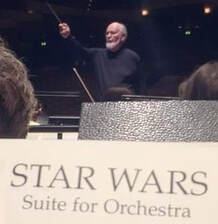
In honor of my "Living Composer Project" (you can read all about it HERE), I decided to give this month's group class a living composer theme!

There are many great living composers to choose from, but I wanted to choose one that my students would be familiar with and that they would be excited to learn more about. Enter one of my favorite living composers: John Williams!
​

Most of my students know John Williams as the composer for the "Star Wars" and "Harry Potter" films. But did you know that he has not only composed the music for over 100 films, but he has also written many concert works--including two symphonies, numerous concertos, and a song cycle for voice and orchestra? He has also composed pieces for significant cultural events, including the Olympics and the U.S. presidential inauguration. With his illustrious career as a composer and conductor, I think John Williams can safely be counted as one of our greatest American composers.

Here are the activities I included in our John Williams group class. I hope these give you a few ideas you can use with your own students!

1. Name That Tune

We kicked off the class with an icebreaker game of "name that tune." I did not tell the students the theme of the class--but I told them that all of the tunes would have something in common! Since I have oodles of pop books featuring arrangements of music by John Williams, I took the first line of several different pieces and had each student in the class sight-read​ a line. I asked the other students in the class to "name that tune."

Once everyone had a chance to sight-read a few lines, I asked the class to guess today's theme. Everyone guessed "movie themes," and then I pointed out that all of the pieces they had heard today had been written by the same composer--John Williams. 

2. Biography of John Williams and Listening Examples

I found a good kid-friendly biography of John Williams HERE on the Making Music Fun website. (There is also a free word search activity sheet, as well as several paid activity bundles, that I did not use if you are looking for more John Williams activities.) I also added a few extra facts from the biography on John Williams' official website, found HERE.

After we read about John Williams' life and career, we listened to some examples of his best-known works. I found a YouTube video with many excerpts HERE--scroll down to see time stamps for each piece. 

Because Williams' music is so descriptive, his pieces provide many opportunities to get students thinking like a composer. They are also great for getting students to listen and identify different instruments in the orchestra. Here are a few of the questions I asked the group as we listened to excerpts of Williams' music:
  • In the theme from "Jaws," how did John Williams create a feeling of suspense? 
  • Williams created contrast in the "Star Wars Theme" by using two different instrument families in the A and B sections of the piece. What were they?
  • What instruments did John Williams use in the opening of the "Olympic Fanfare" to create a majestic feel? 
  • How did John Williams evoke a feeling of magic in "Hedwig's Theme" from Harry Potter?

3. Performance Practice

Unfortunately, I wasn't quite organized enough to have each student prepare a piece by John Williams to perform, so we just used our normal repertoire for this part of the class. However, there are so many great arrangements of his music out there that it would be easy to have each student prepare a John Williams piece if you wanted!

4. Ensemble Practice

I pulled out a couple of my pop books with teacher duet parts (Alfred Popular Hits and Carol Matz's Famous and Fun Pop books) and had students sight-read John Williams pieces in groups of two. My more advanced student played the teacher part, and my less advanced students took turns playing the student parts.

​Once each student had a turn playing in a duet pair, we took the easiest piece and played it as a trio, with one student playing the teacher part, a second student playing the student part, and a third student doubling the student part up high on the piano. This created a nice orchestral sound and was a great way to wrap up our class.  

What do you think? Are you a John Williams fan, or are any of your students? What other ideas would you recommend for a John Williams-themed class? I'd love to hear from you in the comments!
0 Comments

The Living Composer Project

12/29/2018

0 Comments

 
Picture

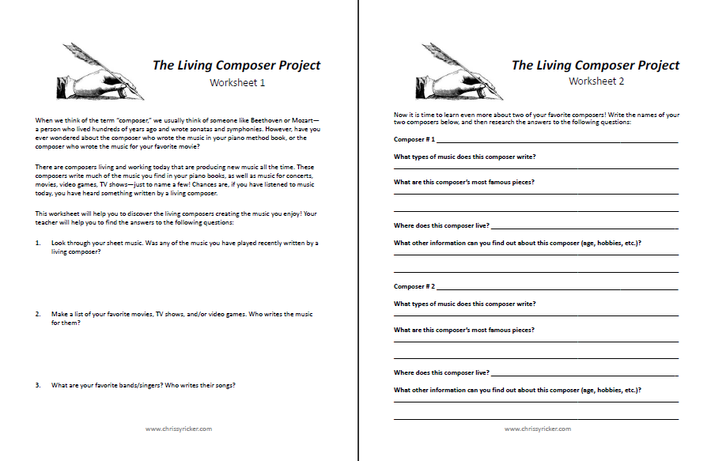
​Who comes to mind when you hear the word "composer?"

For most of my students, the answer to that question is someone like Beethoven or Mozart--a composer who lived and worked hundreds of years ago. And while of course those composers make up an important part of our piano study, I think it is also very important for students to learn about the living composers who are producing new music every day.

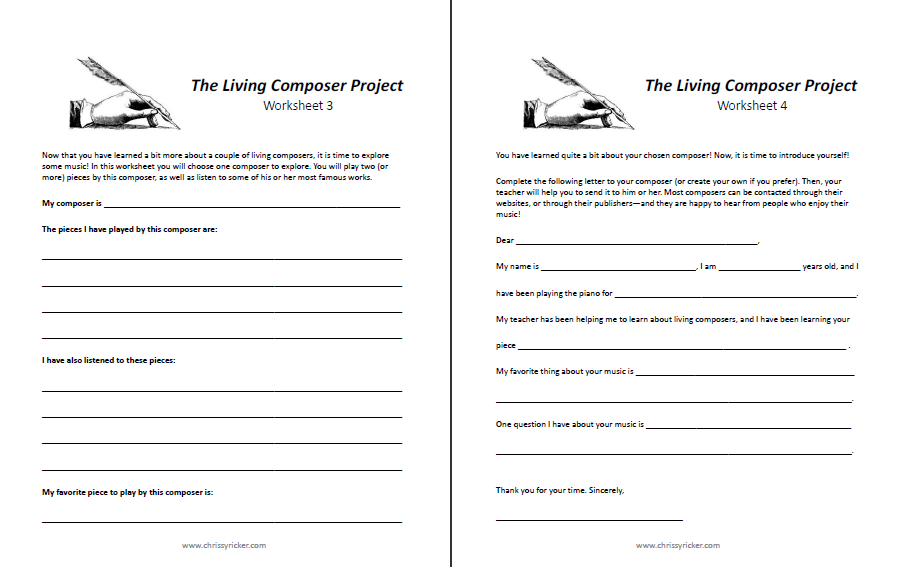
To this end, this spring I will be doing a semester-long project to help my students learn more about the music of living composers. I have created a series of worksheets that will help my students to think more about who writes the music they enjoy each day. I hope these worksheets will help my students to research and listen to new music, as well.

Picture

Picture

​Feel free to download and use these worksheets with your own students if you like! I am planning on doing one worksheet each month with my students, culminating with each student performing a piece by a living composer at our spring recital in May. However, I tried to make the worksheets flexible enough that you may use them however you like. I will also be blogging later this month about the composers my students have discovered in their research.

Click HERE or on the pictures above to download the living composer project worksheets (#1-4).

What do you think? Do you encourage your students to listen to music by living composers? Who are your favorites? Please share your ideas in the comments!
0 Comments
Forward>>

    Author

    Chrissy Ricker is a pianist, teacher, and composer from North Carolina. These are her thoughts on teaching, composing, and all things music.


    Looking for teaching ideas related to a specific topic? Use the "search" feature or scroll down to see blog posts organized by category!

    Archives

    April 2026
    March 2026
    February 2026
    January 2026
    December 2025
    November 2025
    October 2025
    September 2025
    August 2025
    July 2025
    June 2025
    May 2025
    March 2025
    February 2025
    January 2025
    December 2024
    November 2024
    October 2024
    September 2024
    August 2024
    July 2024
    June 2024
    May 2024
    April 2024
    March 2024
    February 2024
    January 2024
    December 2023
    November 2023
    October 2023
    September 2023
    August 2023
    July 2023
    June 2023
    May 2023
    April 2023
    March 2023
    February 2023
    January 2023
    December 2022
    November 2022
    October 2022
    September 2022
    August 2022
    July 2022
    June 2022
    May 2022
    April 2022
    March 2022
    February 2022
    January 2022
    December 2021
    November 2021
    October 2021
    September 2021
    August 2021
    July 2021
    June 2021
    May 2021
    April 2021
    March 2021
    February 2021
    January 2021
    December 2020
    November 2020
    October 2020
    September 2020
    August 2020
    July 2020
    June 2020
    May 2020
    April 2020
    March 2020
    February 2020
    January 2020
    December 2019
    November 2019
    October 2019
    September 2019
    August 2019
    July 2019
    June 2019
    May 2019
    April 2019
    March 2019
    February 2019
    January 2019
    December 2018
    November 2018
    October 2018
    September 2018
    August 2018
    July 2018
    June 2018
    May 2018
    April 2018
    March 2018
    February 2018
    January 2018
    December 2017
    November 2017
    October 2017
    September 2017
    August 2017
    July 2017
    June 2017
    May 2017
    April 2017
    March 2017
    February 2017
    January 2017
    December 2016
    November 2016
    October 2016
    September 2016
    August 2016
    July 2016
    June 2016

    Categories

    All
    2 Minute Teaching Tips
    Active Listening
    Composer Focus
    Composition
    Duets
    Ear Training
    Easter
    Fall/Halloween
    Free Stuff
    Friday Funny
    Games
    Group Classes
    Holiday Music
    Lesson Planning
    Living Composers
    Memorization
    Music For One Hand
    Music History
    Musicianship Monthly
    NFMC Selections
    Online Lessons
    Patriotic Music
    Performing
    Pop Arrangements
    Practicing
    Professional Development
    Repertoire
    Rhythm
    Rote Teaching
    Saint Patrick's Day
    Sight Reading
    Sports Themed Resources
    Summer
    Summer Challenge Calendars
    Technique
    Technology
    Thanksgiving
    Theory
    Tips For Teens
    Transposition
    Travel Teaching
    Valentine's Day
    Wedding Music
    Young Beginners

    RSS Feed

    Subscribe to my monthly newsletter to stay informed about my latest publications and free teacher resources. Once you subscribe below, a fresh newsletter will be delivered to your inbox on the first of each month!

    *Your email will never be shared or used for any other purpose besides this once-monthly newsletter, and you may unsubscribe at any time by clicking "unsubscribe" at the bottom of your newsletter email. 

Subscribe
 © ​Copyright 2016-2026 Chrissy Ricker. All Rights Reserved.
Photos from hyekab25, Giancarlo - Foto 4U, geraldbrazell, djordjemiladinovich, Rosmarie Voegtli, barnimages.com, brownpau, magicatwork, wuestenigel